Free shipping sitewide!* View Details
Free shipping sitewide!* View Details

Search products, categories...
Wheel Spacers Explained: What They Do and What Size You Need
August 21, 2026
0
What Do Wheel Spacers Do?
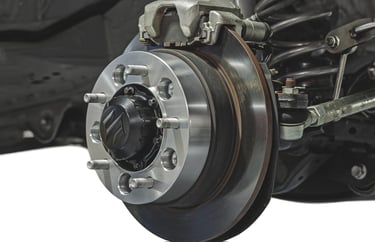
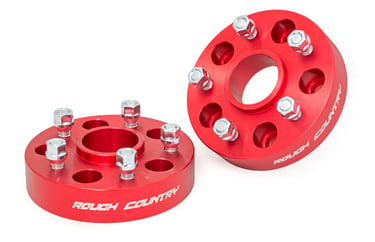
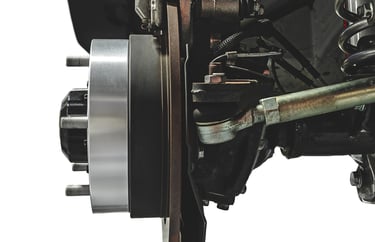
A wheel spacer mounts between the vehicle hub and wheel, moving the entire wheel and tire assembly farther outward.
The spacer thickness determines how far the wheel moves. A 1.5-inch spacer, for example, moves the wheel approximately 1.5 inches farther outward from its original mounting position.
Wheel spacers are commonly used to:
- Create additional clearance between the tire and suspension components
- Make room for certain wider tire setups
- Keep certain factory wheels with a modified suspension setup
- Move wheels closer to the fender line
- Increase track width and create a wider stance
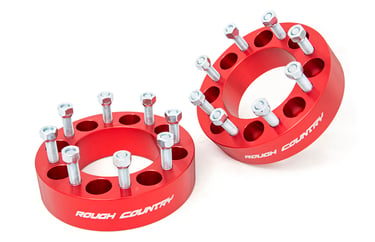
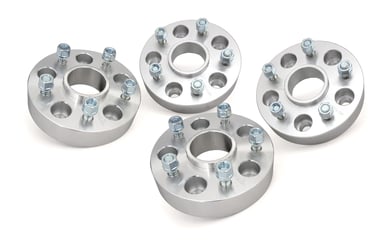
Rough Country offers vehicle-specific wheel spacers in several thicknesses and bolt patterns for trucks, Jeeps, SUVs, UTVs, and ATVs.
When Do You Need Wheel Spacers?
Installing a lift or leveling kit does not automatically mean your vehicle needs wheel spacers.
The need depends on your specific combination of wheels, tires, suspension components, and available clearance.
Here are some of the most common situations where spacers make sense.
Your Tires Sit Too Close to Suspension Components
Larger or wider tires often take up more room inside the wheel well. Depending on the wheel offset and suspension setup, the inside edge of the tire might sit close to a control arm, sway bar, or other component.
Moving the wheel outward creates more room on the inside.
A good Rough Country example is the 0.25-inch 6x135/6x5.5-wheel spacer. Rough Country lists this spacer for certain GM 1500 models using Rough Country 3.5-inch or 4.75-inch lift kits to help retain the factory wheels.
This is a good example of why spacer thickness should match the problem. Sometimes you only need a small amount of additional clearance.
You Want to Run Wider Tires
Wider tires take up more space on both sides of the wheel.
Moving the wheel outward increases inner clearance and gives you more room between the tire and suspension. Rough Country's 2-inch Chevy/GMC 1500 spacers, for example, are designed to move the wheel outward by 2 inches and accommodate wider tire setups.
Moving the tire outward does not eliminate every rubbing issue, though. A tire with more outer clearance might still contact the fender liner, bumper, or body during steering or suspension travel.
Tire size, wheel width, offset, lift height, and trimming requirements still need to be considered together.
Get the Latest from Rough Country
Sign up for our newsletter to receive product updates, exclusive deals, and off-road tips straight to your inbox.
How Do Wheel Spacers Affect Wheel Offset?
Wheel offset describes the position of the wheel's mounting surface compared with the centerline of the wheel.
Adding a spacer moves the wheel outward, creating a similar positioning change to choosing a wheel with less positive offset.
For example, installing roughly 25 mm of spacer thickness moves the wheel outward roughly 25 mm.
This relationship matters when you are trying to decide between:
- Keeping your current wheels and adding spacers
- Buying wheels with a different offset
- Changing both wheels and tire size as part of a larger build
If you are already replacing your wheels, choosing the proper wheel width and offset might provide the stance and clearance you want without adding a spacer.
What Size Wheel Spacers Do You Need?
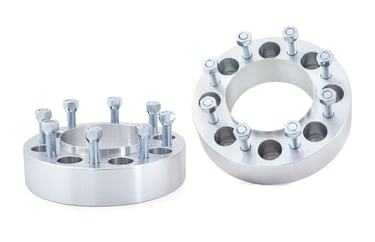
There is no single spacer size that works best for every truck, Jeep, or UTV.
Start with why you need the spacer.
0.25-Inch Wheel Spacers
A thin spacer works well when you only need a small amount of additional clearance.
Rough Country currently offers 0.25-inch options for several applications. One version fits both 6x5.5-inch and 6x135mm bolt patterns and is designed around specific truck and suspension combinations.
A spacer this thin makes far less of a visual difference than a 1.5-inch or 2-inch spacer. Its main purpose is often fitment rather than creating an aggressive stance.
1.5-Inch Wheel Spacers
A 1.5-inch spacer makes a much more noticeable change in wheel position.
Rough Country currently offers 1.5-inch spacers for applications including Jeep Wrangler models, Toyota Tacoma and 4Runner models, and several UTVs.
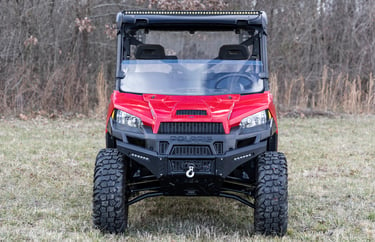
Rough Country's UTV lineup includes 1.5-inch spacer options for models from Can-Am, CFMOTO, Honda, Polaris, and Yamaha.
For UTV owners, the wider track also changes the stance and provides additional room between the wheel and suspension components.
2-Inch Wheel Spacers
A 2-inch spacer creates an even larger change.
Rough Country offers 2-inch options for applications including Ford F-150 and Super Duty trucks, Jeep Wrangler and Gladiator models, Chevy and GMC trucks, and Ram trucks.
A spacer this thick should solve a specific fitment or stance goal. More spacing is not automatically better.
How to Measure for Wheel Spacers
Before choosing a spacer, look at where your tire sits now.
Check the distance between the inside of the tire and the closest suspension or steering component. Then determine how much farther outward the wheel needs to move.
You should also check outer clearance.
Moving the wheel outward creates additional space inside the wheel well, but decreases clearance between the tire and components such as the fender, flare, liner, or bumper.
Check clearance with:
- The steering turned fully left and right
- The suspension at normal ride height
- The suspension compressed, where practical
- Your intended tire size installed or accounted for
Choose the smallest spacer thickness that achieves the clearance and stance your setup requires.
What to Check Before Buying Wheel Spacers
Spacer thickness is only one part of proper fitment.
Before ordering, confirm:
- Vehicle year, make, and model
- 2WD or 4WD where applicable
- Wheel bolt pattern
- Center bore
- Wheel stud and thread specifications
- Current wheel size and offset
- Tire size
- Available inner and outer clearance
- Compatibility with your lift or leveling kit
Rough Country lists fitment notes with each wheel spacer, so check the product page for your specific vehicle rather than ordering based on thickness or bolt pattern alone.
Do Wheel Spacers Affect Steering or Suspension?
Moving a wheel farther outward changes its position in relation to the hub and suspension.
A larger change in wheel position also changes the leverage placed on components such as wheel bearings and changes suspension geometry factors such as scrub radius.
For most builds, the goal should be to use the spacer thickness needed for the intended setup rather than moving the wheels outward farther than necessary.
Proper installation matters as much as spacer selection. Follow the instructions supplied with the spacer, use the specified torque values, and check the hardware as directed after installation.
FAQs
Are wheel spacers safe for daily driving?
A properly matched wheel spacer installed according to the manufacturer's instructions is designed for its listed vehicle applications. Correct bolt pattern, hub fitment, thread engagement, torque, and installation all matter.
Always follow the fitment notes and installation instructions for your specific Rough Country spacer.
Do wheel spacers stop tire rubbing?
Wheel spacers help when the tire rubs against an inner suspension or steering component.
They do not solve every type of tire rubbing. Moving the tire outward sometimes creates contact with the fender, liner, bumper, or flare instead.
Identify where the tire rubs before deciding whether a spacer is the right fix.
Do I need wheel spacers with a lift kit?
Not every lift kit requires wheel spacers.
Some combinations of factory wheels, larger tires, and suspension components need additional clearance, while others fit without spacers.
Check the tire and wheel recommendations listed for your Rough Country lift kit before ordering additional parts.
Do I need an alignment after installing wheel spacers?
Wheel spacers do not adjust camber, caster, or toe the same way a suspension modification does.
If the spacers are installed along with a lift kit, leveling kit, control arms, or other suspension changes, follow the alignment recommendations for those parts.
![Jeep 1.5in Wheel Spacers [1090RED]](https://media.prod.roughcountry.com/cdn-cgi/image/width=155,format=webp,fit=cover/media/catalog/product/1/_/1_5in_wheel_spacers_tj_yj_zj_mj_-_1090red.jpg)

![2-inch Wheel Spacers [8 x 6.5]](https://media.prod.roughcountry.com/cdn-cgi/image/width=155,format=webp,fit=cover/media/catalog/product/2/i/2in_wheel_spacers_gm_hd_ram_2500-3500_-_1099red_1095red.jpg)
![2-inch Wheel Spacers (6 x 135]](https://media.prod.roughcountry.com/cdn-cgi/image/width=155,format=webp,fit=cover/media/catalog/product/1/0/10087.jpg)